

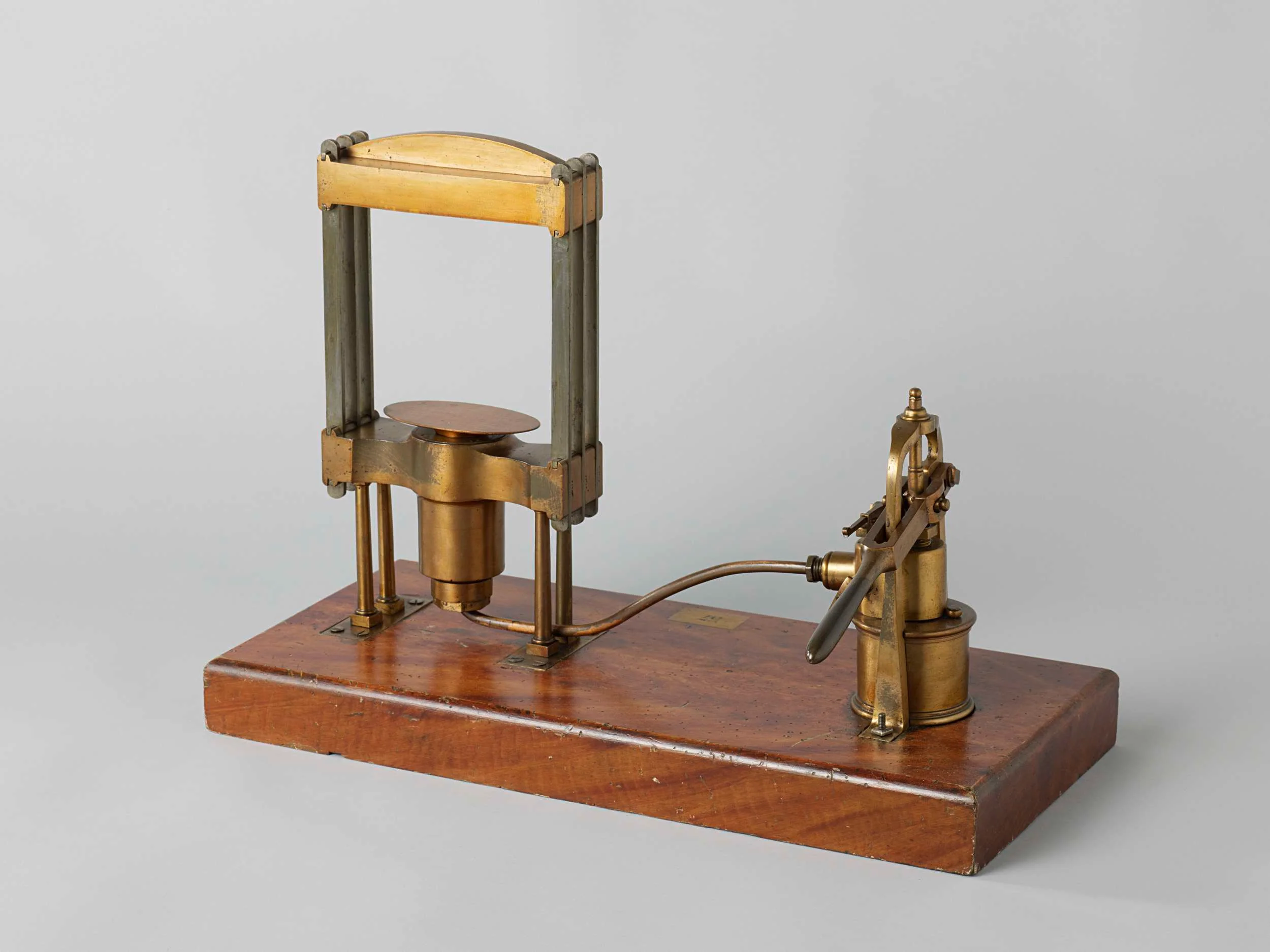

Hydraulic presses are seen crushing cars, shaping metal, and even making diamonds. But at the heart of all this immense power lies a simple law of physics discovered over 300 years ago: Pascal’s Law.
Pascal’s Law states that pressure applied to a confined fluid is transmitted equally in all directions. This means that when a small piston pushes hydraulic fluid into a larger piston, the force at the larger piston multiplies. In short: a small push can create a massive force.
A Brief History
Modern day fluid mechanics was pioneered by Blaise Pascal in 1648. The French physicist discovered that pressure in a confined newtonian fluid exerts an equal pressure in all directions at all points in the fluid and container. About 100 years later in 1738, Daniel Bernoulli applied Pascal’s principles to dynamic fluid situations such as pumps, mills, and turbines. Then comes Joseph Bramah who patented the first hydraulic press in England in 1795. Since then, hydraulics have powered factories, machines, and even garbage trucks.
Pascal’s Law Explained
Pascal’s Law is simple: Pressure = Force / Area. This is the beautiful and simple relationship that Pascal discovered between Pressure and Force. Fun fact: The units for pressure used in the metric system is Pascals or Pa, named after Blaise Pascal.

Using the simple equilibrium illustration above, you can see that pressure is constant throughout the system However, because A2 is larger than A1, we are able to multiply the force of F1 by the ratio of areas between A2:A1 to create a larger force F2. You can see how this might be useful in a practical sense when you are needing more force than you can produce, use a hydraulics to multiply the origin force. It’s very similar to a gear reduction in the gear box, which creates more torque. The “down” side is much more vertical displacement is required in the small cylinder to move the larger cylinder.
Core Components
There are many different designs and complexities to hydraulic pumps. Below is a very simple diagram and is essentially how a manual car jack works. Think about the amount of force required to lift a car, thanks to the implementation of basic hydraulics and utilizing leverage, anyone is able to lift a car with ease.

- Reservoir: Stores low pressure fluid
- Pump: Applies pressure to plunger
- Plunger (Small Piston): Where the input force is applied to the fluid
- Cylinder: Where the pressurized working fluid is stored and pushing against the piston/ram.
- Ram (Large Piston): Delivers amplified output force.
- Victim: The working material or object in the hydraulic press
- Return Valve: Depressurizes and resets the system
Step-by-Step Process
- Pump forces hydraulic fluid into cylinder
- Plunger (Small Piston) applies pressure to fluid.
- Ram (Large Piston) multiplies the original force from the pump
- Object is pressed, crushed, or formed
- Valve releases pressure to reset system
Different Types of Hydraulic Presses
- Manual Hydraulic Press: These use handles and a lever to operate similar to the previous example.
- An example of this would be a car jack, you ever wondered how you are able to lift a car with seemingly no effort? That’s the power of hydraulics.
- Automatic Hydraulic Press: These use motors to drive a hydraulic pump and electric switches for relief valve controls and precision.
- These are typically used in industrial applications. These are highly versatile and a lot go the times the cylinders/ram are not visible.
- These are also used in many youtube videos to smash and destroy a variety of objects, the hydraulic press wins 99/100 times.
- Specialized: Like press breaks, shears, and compactors.
Real World Applications
Hydraulic presses have a variety of uses in the manufacturing world. They are much more important and useful than just creating videos for our entertainment (Though I do enjoy those videos)
Metal Forming
The concept of the hydraulic press is used in metal forming, stamping, cutting, and forging. All industrial machines will likely be hydraulically driven as that is the easiest and most effective way to produce high forces at high density. Many of these machines have CNC capabilities that ensure precision in the final product. The combination of hydraulic power and electronics has made it possible make much larger/heavier equipment, while also being precise on the smallest scale.
Recycling
Garbage trucks use hydraulic presses to compact the waste in order to fit more trash in their trucks. Dumps use larger hydraulic presses to compact bulkier items, making it take up less space in the land fills. Car crushers at some junk yards use this same concept and you may even see cardboard compactors at your workplace or in your community that likely uses this concept as well.
High Tech
Some of the previous examples of hydraulic presses being used were crude, but they are also used in a lot of high tech industries. One of the industries where hydraulic presses are pivotal to their business is lab grown diamonds. Using a diamond seed coated in pure carbon, High Pressure-High Temperature manufacturing process is used to create it. This is to mimic the conditions deep within the Earth’s mantel needing pressures up to 5 GPa (750 KSI).
Hands on learning
If you want a deeper understanding of how a hydraulic press works, I find that the best way is to replicate it at home. Build a safe small-scale version at home, all you need are a couple of plastic syringes of different sizes, vinyl tubing, and some water. Fill the tubing with water so there are no air bubbles, connect both syringes, and then push down on the smaller one – you’ll see the larger syring move with more force than put in. If you want to take it further, mount the syringes on a cardboard of wooden frame and use the larger piston to crush a soda can or lift a small weight.
Want to try it yourself? Stay tuned for a DIY hydraulic press project using household items and syringes — perfect for students and curious makers.
Conclusion
The hydraulic press is an excellent example of leveraging physics to work for us. The saying “Work smarter, not harder”, is a great description of utilizing physics. The use of Pascal’s Law was a genius application of a physical phenomenon. It lead to creative engineering solutions for manufacturing practices, production efficiency, and opened up a new platform for heavy/industrial machinery.
The hydraulic press proves that sometimes the most powerful machines are based on the simplest principles. Thanks to Pascal’s Law a little push can move mountains – or at least flatten a soda can.